Quick answer: a barrier gate needs a short weekly walk-round by site staff, a monthly test of the safety devices, a quarterly mechanical and electrical service, and an annual overhaul — with every interval shortened on high-cycle lanes such as paid parking, hospital and logistics entrances. Springs, the boom arm, the loop detector and the backup battery are the parts that decide whether the lane keeps working.
Most barrier gate failures are not sudden. A counterbalance spring loses tension over thousands of cycles, a loop detector drifts out of tune after pavement work, a photocell lens films over with dust and rain, and a backup battery ages quietly until the morning the power fails. Every one of those is cheap to catch at a scheduled visit and expensive to discover at 8 a.m. on a Monday with a queue at the entrance.
This guide is written for the people who keep vehicle entrances running: facility managers, security supervisors, integrators and maintenance contractors. It sets out what a service plan should contain, how often each task is due, which jobs site staff can do safely and which belong to a qualified technician, and how to use the cycle counter to replace parts before they fail. If you are still choosing hardware, the site-preparation and commissioning side is covered separately in our barrier gate installation and maintenance guide.
What a barrier gate service plan should contain
A workable plan has four parts: a task list with a frequency for each task; a pass or fail criterion, so the result is not a matter of opinion; a named owner for every task; and a written record. Without the record, repeat failures look like bad luck instead of a pattern — and a pattern is exactly what tells you that a spring, a loop detector or a whole operator unit has reached the end of its working life.
Start with an inventory of every gate on site: model, motor type, arm length, safety devices, controller and installation date. That list is what makes the rest of the schedule practical, because intervals and spare parts differ between a light arm on an office exit and a heavy-duty arm on a logistics gate.
How often should a barrier gate be serviced?
The table below is a starting frame for a moderately busy entrance. Shorten every interval for a high-cycle lane; a quiet entrance can sit at the longer end. The manufacturer's manual is the baseline, and your cycle counter is the adjustment.
| Site type | Typical traffic | Weekly walk-round | Monthly safety test | Quarterly service | Annual overhaul |
|---|---|---|---|---|---|
| Gated community, office or campus entrance | a few hundred cycles a day | Yes | Yes | Yes | Yes |
| Retail, hospital or mixed-use car park | several hundred to over a thousand cycles a day | Yes, twice a week | Yes | Yes | Yes |
| Paid parking, logistics yard, toll or weighbridge lane | over a thousand cycles a day | Daily | Yes, monthly or more often | Yes | Yes |
Two factors move the whole schedule: duty and environment. Motor type, arm length and daily cycles decide how much heat and mechanical wear the operator accumulates, while wind, dust, salt air and standing water add loads that the datasheet never mentions. A gate that cycles a thousand times a day in a coastal car park is a fundamentally different maintenance object from the same model on a quiet residential street.
The weekly walk-round: five to ten minutes per lane
Most of the value of a weekly check is that it is short enough to actually happen. A trained staff member needs no tools for the first six items.
- Arm and reflection. Is the boom straight, without a visible droop at rest? Are the reflective strips, edge markings or skirt intact and clean, so drivers can see the arm at night and in rain?
- Arm rest and tip support. The rest should meet the arm squarely, not support it in the air or let it slam.
- Cabinet and base. Check for new dents, panel damage, water pooling at the base, blocked drain holes or missing covers. A cabinet that holds water will eventually hold a fault.
- Lane surface. Sweep away metal debris, gravel and sand from the loop area, and clear standing water. Debris and water over a buried loop are among the most common causes of a gate that stops detecting or refuses to close.
- Photocell and sensor lenses. Wipe both lenses with a dry cloth and check that the beam path between them is clear of cobwebs, cardboard and overgrown planting.
- Lane markings and signage. Warning signs, stop lines and one-way markings should be legible; faded markings invite the vehicle strikes that generate repair work.
- Every trigger. Operate the gate from each method in turn — remote control, keypad or reader, exit loop and any push button at the guard post — and confirm it opens from all of them.
- The safety test. For a busy lane, test the anti-crush function weekly: drive or place a soft test object in the lane and confirm the arm neither lowers onto it nor continues to close. A gate that closes on a vehicle is a hazard to be taken out of automatic operation, not an inconvenience to live with until the next service visit.
- One full cycle, listening. Run the gate through a complete open and close and listen. Grinding, straining, a new squeal or a hesitation in the arm are early mechanical warnings.
The monthly visit: testing the safety devices
Safety devices are the only part of a barrier gate where “probably working” is not an acceptable answer. Test them on a schedule, and record who tested, when, and what the result was — that log is your evidence if an incident is ever questioned. The method for each device differs, so it helps to know how the sensor layer is built before you start testing it; our guide to barrier gate safety sensors covers the device types and how entrapment protection is normally wired.
| Device | How to test it | Pass criterion | If it fails |
|---|---|---|---|
| Inductive loop detector | With the arm closing, rest a vehicle or a metal object over the loop | Arm stops and reopens | Clean the loop area, check the detector sensitivity and loop wiring |
| Photocell or infrared beam | Break the beam by hand while the arm is closing | Arm stops and reopens | Clean and re-align the lenses, then check the wiring and supply |
| Safety edge on the arm | Apply light pressure to the edge while closing | Arm stops and reverses | Inspect the edge strip and its transmitter or battery |
| Obstruction sensing by the motor controller | Place a soft test object in the arm path | Arm stops and reverses within a moment of contact | Adjust controller sensitivity under technician guidance |
| Manual release | Disengage the drive and raise and lower the arm by hand | The arm moves freely | Lubricate the release mechanism and check the key is present at the post |
Test each device with the gate in automatic mode and with the drive disengaged, and never disable a safety device to make a stubborn lane work — that converts a nuisance fault into a liability. Because the boom is a rigid, visible object, entrapment protection is the section of the system that auditors and insurers ask about first.
Quarterly and annual service: the technician's scope
- Counterbalance and arm balance. With the drive disengaged, the arm should sit roughly where it is placed instead of dropping or rising. Re-tensioning a spring is a technician task and a dangerous one; the procedure is described in our barrier gate spring adjustment guide.
- Motor, gearbox and drive. Listen to the drive under load, check for play, heat or oil seepage, and compare motor current with the manufacturer's figure. A rising current usually means mechanical resistance rather than a failing motor.
- Limit positions and closing force. Verify that the arm stops horizontally and vertically, and that the force limits still trip on obstruction.
- Loop detector tuning. Re-check sensitivity and frequency after any pavement work, resurfacing, sealing or nearby electrical work; a detector that was tuned before the lane was resurfaced is the classic source of phantom openings.
- Controller, firmware and configuration. Verify timing, hold-open time, soft-stop and anti-crush settings, back up the configuration, and keep a copy of the parameters with the gate record. Details of the control and communication layer are in our barrier gate components guide.
- Housing, seals and finish. Check gaskets, gland entries and drain holes, and touch up chipped paint before rust starts. Cabinets in the range we supply are built to IP54 protection, which still depends on those seals being intact.
- Mounting and foundation. Check anchor bolt torque, look for cracks or settling in the concrete pad, and inspect protective bollards or kerbs for impact damage.
- Electrical safety. Inspect terminations, earth connection and surge protection, and tighten what thermal cycling has loosened. Mains work belongs to a licensed electrician.
- Backup battery. Disconnect the mains supply in a controlled test and confirm the gate completes several cycles on battery; a battery that sags under load is a failure waiting for a power cut. Our battery backup guide explains the sizing and testing side.
Which tasks site staff can do — and which they must not
Keeping the line in the right place is what makes a maintenance plan safe and affordable. Site staff can clean lenses, clear the loop area, check the arm and its reflective markings, test the manual release, run the anti-crush test, replace remote-transmitter batteries and keep the log. Everything involving spring tension, the inside of the operator, the mains supply, loop tuning and limit settings belongs to a trained technician.
A compressed counterbalance spring stores enough energy to cause injury, so it should never be adjusted by untrained staff. The same rule applies to the mains side of the controller, including wiring, earthing and contactors. If a gate has been hit by a vehicle, treat the lane as out of service until the arm, the drive and the foundation have been inspected.
Use the cycle counter to plan replacements
Every operator keeps count of its cycles, either on a display or in a diagnostic register. That number is the most useful planning tool you have, because wear on a barrier gate is driven by cycles rather than by the calendar. Compare the counter with the published life rating of the unit, and treat the comparison as a planning signal rather than a promise about a particular gate.
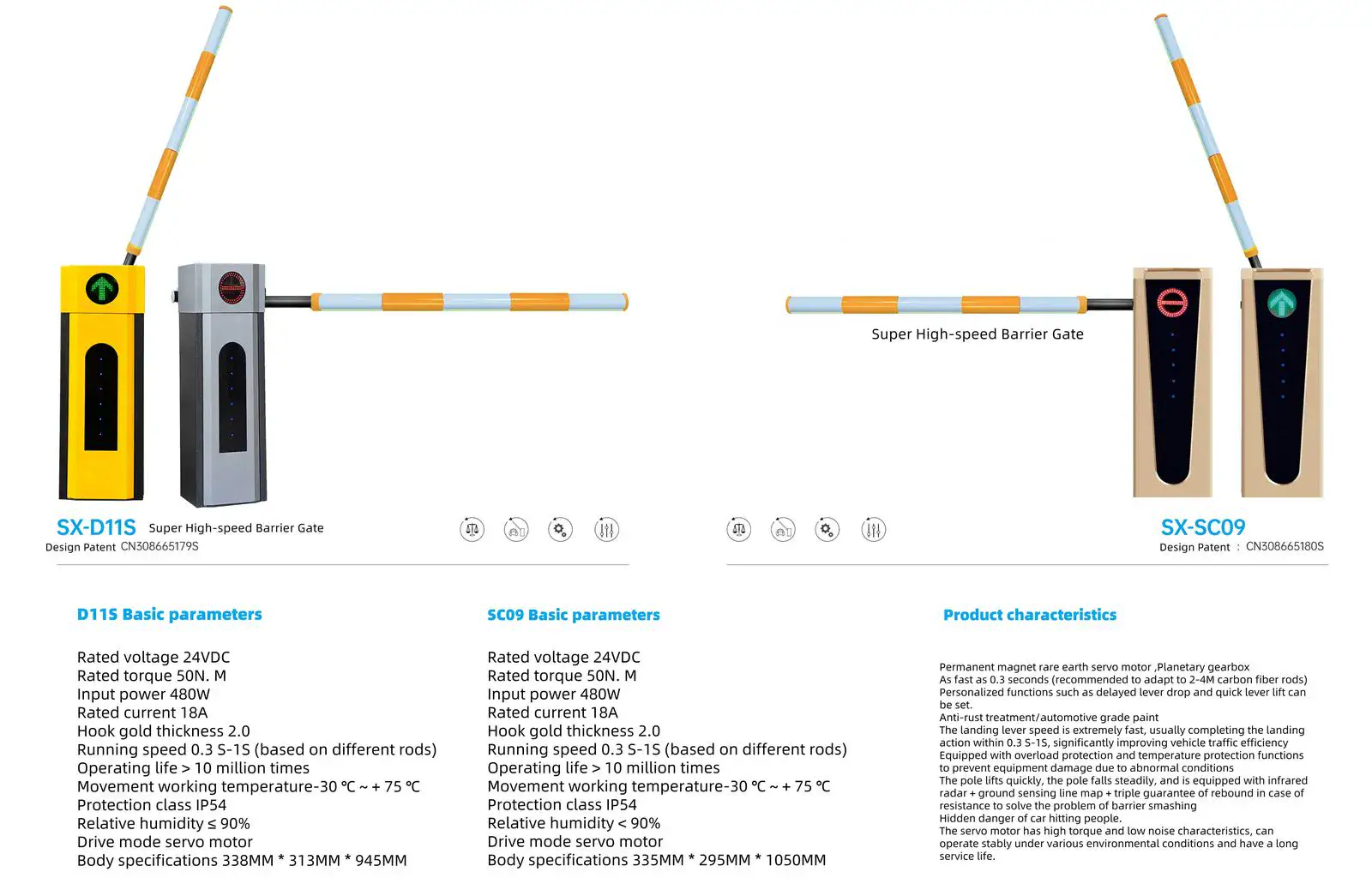
For context on how those ratings are quoted: in our own range, the DC brushless intelligent barrier gates are rated for over 1,000,000 cycles, our premium models reach a mean cycles between failures of over 5 million cycles, and the super high-speed servo model is rated for over 10 million cycles. Those figures come from different test conditions and motor types, which is why they should never be compared across manufacturers without asking what the number describes.
| Part | What to watch | Typical replacement trigger |
|---|---|---|
| Counterbalance spring | Tension, corrosion, noise at the top of travel | Fall-out-of-balance that cannot be re-tensioned, or visible corrosion at the coils |
| Boom arm and reflective strip | Straightness, cracks, faded or missing reflective tape | Vehicle strike, a bend that cannot be corrected, or markings that no longer read at night |
| Backup battery | Capacity under load, terminal corrosion, age | Fewer cycles than usual during a power-cut test, or an ageing pack reaching the end of its service life |
| Loop detector and loop | Phantom openings, missed detections, sealant cracking over the slot | Repeated false triggers after retuning, or visible damage to the sealed slot |
| Photocells and safety edge | Alignment, lens condition, beam strength | Any failed monthly test that cleaning and alignment do not fix |
| Remote transmitters and receiver | Range, intermittent response, worn buttons | Failing range after a battery change, or a transmitter that no longer pairs |
| Seals, gaskets and paint | Water inside the cabinet, rust at the base | Moisture found during a service visit |
Keep a small spare kit for each model on site — a pair of photocells, a transmitter, a loop detector, seals and a battery — so that a fault does not turn into a week of manual barrier operation. Spare parts are interchangeable across a factory series, and asking for the controller documentation and parameter list at handover is the simplest way to make future servicing faster.
High-cycle lanes: paid parking, hospitals and logistics
At a paid parking exit, a hospital entrance or a dispatch yard, the gate may cycle more often in a week than a residential barrier does in a year, and traffic arrives in peaks. Compress the whole schedule: daily rather than weekly visual checks, monthly safety testing, and quarterly mechanical work. Choose hardware with the duty rating to match, because a light-duty operator pushed into continuous service will spend the rest of its life being repaired rather than used.
On heavy-duty lanes, the parts that dominate the failure record are the spring, the drive and the loop. If the site is being specified from scratch, it is worth comparing drive types before the order is placed rather than after the first summer of continuous operation; our DC brushless versus AC barrier gate comparison sets out where each drive type belongs, and the high-speed barrier gate guide explains how opening time, duty cycle and operating life interact on fast lanes.
Site conditions that shorten the interval
- Cold. Grease stiffens and batteries lose capacity in low temperatures. Our series is rated for operation from −30 °C to +75 °C, but the maintenance interval still needs to follow the climate rather than the datasheet.
- Coastal or industrial air. Salt and chemical atmospheres attack fasteners, seals and paint, and reach the electronics through a damaged gasket.
- Dust, sand and cement. Construction traffic wears pivots and fills the loop slot; clean the area more often during site works.
- Wind and long arms. A long arm in an exposed location loads the drive and the spring every cycle. Check arm straightness, tip support and anchor bolts more frequently.
- Water and drainage. A lane that floods, or a grade that sends runoff into the cabinet, needs drainage work before it needs more spare parts.
- Pavement works. Saw-cutting, resurfacing or sealing near a buried loop changes its inductance. Retune the detector and re-seal the slot afterwards; the alternative is a lane that opens at random.
- Power quality. Sites with frequent outages, generator switching or nearby lightning activity should treat surge protection and the backup battery as consumable items.
The log, and what to ask a supplier
Record the date, the gate or lane, the person who did the work, the tasks completed, the readings taken, the parts replaced, and any fault left open. Twelve months of that log turns maintenance from a series of visits into a data set: it shows which lane fails, how often, and whether the site would be better served by a different drive, a shorter arm or a scheduled spring replacement.
When you buy barrier gates, ask for the information that makes servicing possible: a controller manual and parameter list, part numbers for the spring, arm, photocells and detector, the documented operating life of the model, and the factory's route for technical questions and spares. We have been manufacturing vehicle barrier gates since 2010 in an ISO 9001-certified factory with two production bases and a 10,000 m² workshop, exporting to more than 50 countries, and compliance documentation such as CE and RoHS or SGS reports can be requested with a project. A factory-direct supplier can also tell you which parts are interchangeable across the range, which is what keeps a maintenance budget predictable.
Build the plan in one afternoon
- Inventory every gate: model, drive, arm length, safety devices, controller, installation date and cycle counter.
- Write the task list for the week, the month, the quarter and the year, with a pass criterion for each item.
- Name an owner for each frequency — site staff for the walk-round, a technician for the mechanical and electrical work.
- Set the intervals from the cycle count, then shorten them for cold, coastal, dusty or windy sites.
- Stock a small spare kit and print a log sheet; keep it with the gate, not in an office drawer.
- Review the log every quarter and let it change the schedule.
Scheduled maintenance on a barrier gate is not an overhead on top of the equipment; it is the difference between an entrance that opens on demand and an entrance that has to be staffed manually. Test the safety devices, watch the spring and the loop, replace parts against the cycle counter — and the lane you specified will still be working years after the first service visit.
FAQ
How often should a barrier gate be serviced?
For a moderately busy entrance, plan a weekly visual walk-round, a monthly test of the safety devices, a quarterly mechanical and electrical service and an annual overhaul. On lanes above roughly a thousand cycles a day, shorten every interval — daily visual checks, monthly safety testing and quarterly mechanical work.
Which maintenance test matters most?
The anti-crush test. With the arm closing, a vehicle or a soft test object in the lane must stop the arm and send it back up. If a gate ever closes on or toward a vehicle, take it out of automatic operation, run it manually and call a technician.
Can facility staff do the maintenance themselves?
Cleaning lenses, clearing the loop area, checking the arm and its reflective markings, testing the manual release, running the anti-crush test, replacing remote-transmitter batteries and keeping the log are all safe for site staff. Spring tension, the inside of the operator, mains wiring, loop tuning and limit settings belong to a trained technician.
When does the counterbalance spring need replacing?
Watch for an arm that no longer stays where it is placed, noise at the top of travel and corrosion on the coils. Springs are re-tensioned at service; they are replaced when balance can no longer be restored, because a compressed spring stores enough energy to cause injury and is not a do-it-yourself part.
How do I know the loop detector needs retuning?
Phantom openings, missed detections or a gate that refuses to close usually follow pavement work, resurfacing, sealing or electrical work near the buried loop. Retune the detector and re-seal the saw cut after any of those works.
What spare parts should be kept on site?
A pair of photocells, a remote transmitter, a loop detector, cabinet seals and a backup battery per model. Parts are interchangeable within a factory series, and asking for the controller manual and parameter list at handover makes every later service visit faster.
Get a Factory-Direct Quote
Send your project details — lane width, traffic volume and site photos — and our engineering team will reply with a specification, lead time and factory-direct quotation.