Table of Contents
What Is a Boom Barrier Gate?
A boom barrier gate — also called a boom gate, barrier gate, parking barrier, or automatic rising arm barrier — is an electro-mechanical access control device that uses a pivoting horizontal arm (boom) to allow or restrict vehicle entry. When authorized, the arm rises vertically; when closed, it blocks the lane horizontally.
Boom barriers are the most widely deployed vehicle access control solution globally, installed in parking lots, toll plazas, industrial facilities, residential communities, and government buildings. Modern barrier gates integrate with RFID readers, license plate recognition (LPR/ANPR) cameras, loop detectors, remote controls, and access control software platforms.
Types of Boom Barrier Gates
By Motor Technology
DC Brushless Barrier Gates: Powered by 24V DC brushless motors. Key advantages: energy-efficient, low noise operation, longer lifespan (5–10 million cycles), adjustable speed, and automatic opening during power failure. Ideal for high-traffic parking and toll applications.
AC Motor Barrier Gates: Traditional AC-powered models. Cost-effective, proven reliability, but typically louder and less energy-efficient than DC brushless alternatives. Suitable for medium-traffic applications.
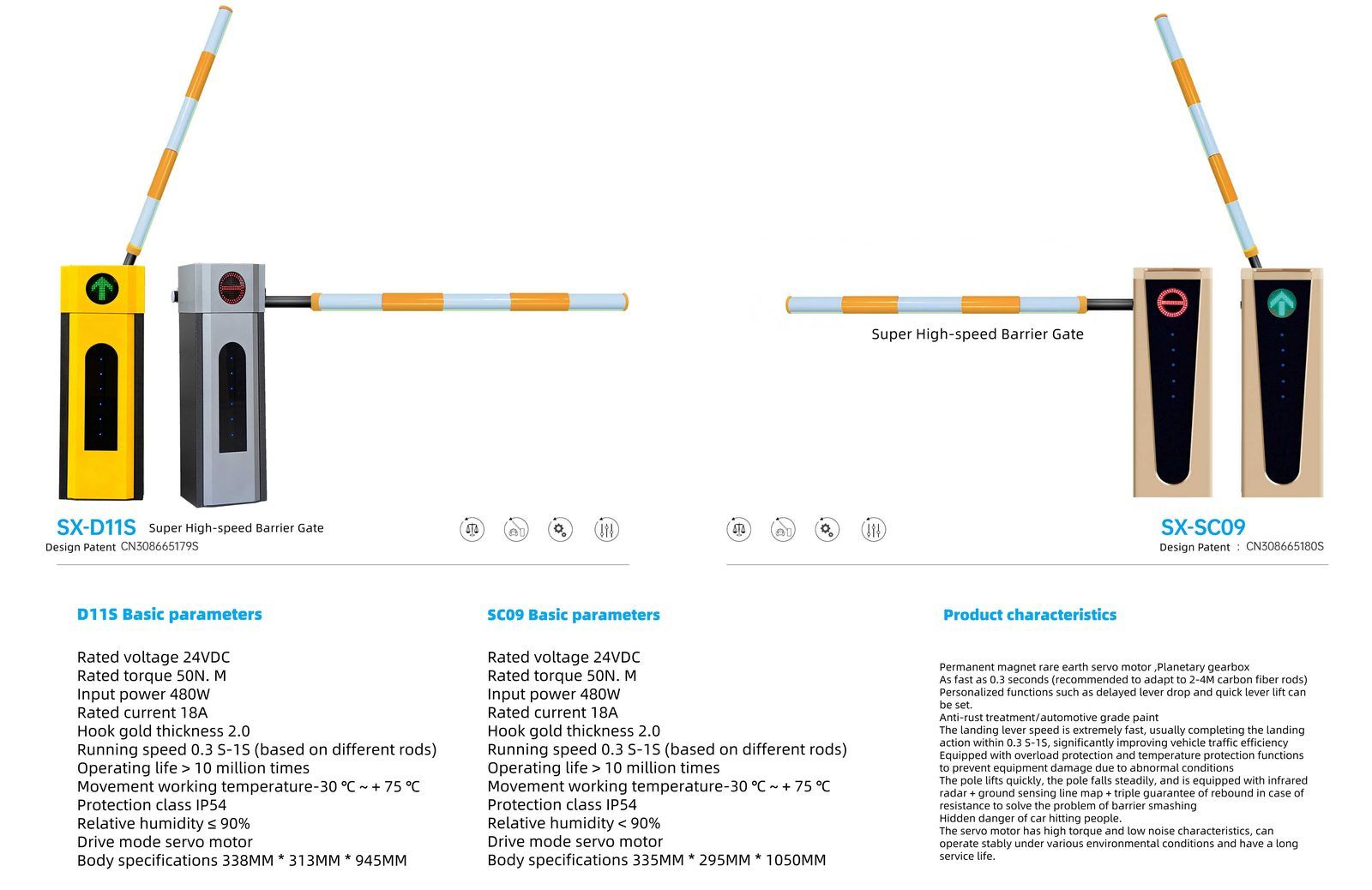
Servo Motor Barrier Gates: High-precision servo-driven gates with the fastest operation speeds (as low as 0.3 seconds). Highest cycle lifetime (10+ million), ideal for highway toll and ultra-high-traffic sites.
Hydraulic Barrier Gates: Hydraulic-powered gates for heavy-duty applications, long arm lengths, and windy environments. Smooth, powerful movement.
By Boom (Arm) Type
Straight Arm Boom: Standard single horizontal arm. Most common type for 3–8m lanes.
Folding (Articulated) Boom: Hinged folding arm for low-ceiling areas such as underground parking garages.
Fence Boom Barrier: Boom with vertical fencing/skirting to prevent pedestrians or animals from passing under the arm.
Telescopic Boom: Retractable arm design for variable lane widths. Space-saving option.
Key Specifications Explained
MCBF (Mean Cycles Between Failures): The most important reliability metric for barrier gates. Represents the average number of complete open-close cycles before a failure occurs. For high-traffic sites, look for MCBF of 3 million or higher.
IP Rating (Ingress Protection): Indicates dust and water resistance. IP54 is standard for outdoor barrier gates; IP65 offers superior protection against dust and water jets.
Duty Cycle: The percentage of time the motor can operate continuously. For parking lots with frequent use, choose a barrier gate rated for continuous duty (100% duty cycle).
Speed (Opening/Closing Time): Ranges from 0.3 seconds (servo, high-speed) to 8 seconds (heavy-duty, long arm). Faster speeds improve traffic flow but may not be necessary for all applications.
Arm Length: Standard options: 3m, 4m, 5m, 6m (straight); extended options up to 12m with support posts. Match arm length to lane width with 200–300mm overlap on each side.
Common Applications
- Parking Lots: Commercial, hospital, mall, and airport parking entrances/exits
- Highway Toll Stations: High-speed, high-durability models for 24/7 operation
- Industrial Parks & Factories: Vehicle and truck access control
- Residential Communities: Gated community entrance management with RFID
- Government & Military: Crash-rated and hydraulic barriers for high-security sites
How to Choose the Right Barrier Gate
1. Determine your traffic volume — low (residential), medium (commercial parking), or high (highway toll). This determines duty cycle and MCBF requirements.
2. Measure your lane width — this determines arm length and whether you need a single or double-bar solution.
3. Consider your environment — outdoor vs indoor, temperature range, dust/water exposure (IP rating).
4. Plan your integration — will you connect to LPR, RFID, loop detectors, traffic lights? Ensure the barrier gate control board supports your required interfaces (RS485, TCP/IP, relay outputs).
5. Decide on power — AC grid power or DC/solar for off-grid sites.
Frequently Asked Questions
What is the difference between a boom barrier and a boom gate?
They refer to the same product. "Boom barrier" is more common in Europe and Asia; "boom gate" is more common in Australia and the UK; "barrier gate" is more common in North America.
How long do boom barrier gates last?
Quality barrier gates typically last 5–10 years or 5–10 million cycles, depending on motor type, usage frequency, and maintenance. DC brushless and servo models offer the longest service life.
Can barrier gates be customized for OEM projects?
Yes. At BOOM BARRIER GATE FACTORY, we offer full OEM/ODM customization including color, logo, housing design, arm length, control board configuration, and packaging to match your brand requirements. Contact us to discuss your project.