In this guide
- Why US fire codes treat a gate as an obstruction
- What counts as an approved means of emergency operation
- Which opening method each type of site uses
- The clear-width, clearance and setback numbers
- How the operator itself has to be built, listed and wired
- What to put in a factory-direct order
- How to pass the fire marshal's inspection and stay compliant
A gate that controls vehicle access and also sits on a fire apparatus access road is the one piece of access-control equipment that a fire marshal can order you to open — or to leave permanently open. It is reviewed with the site plan, it needs its own permits, and if the emergency device stops working, the approval that lets the gate exist can be withdrawn.
This guide is written for the people who specify and buy these gates in the United States: property managers, HOAs and community associations, general contractors, gate and access-control integrators, and security resellers. It covers what the fire code asks for, what fire-prevention bulletins from US departments typically demand in detail, what that means for the barrier gate you order, and how to source factory-direct without losing the documentation an inspector will ask for.
Why Do US Fire Codes Treat a Barrier Gate as an Obstruction?
A fire apparatus access road is the route a fire engine or ladder truck uses to reach a building. The International Fire Code (IFC) expects that route to stay usable, and a closed gate is a deliberate break in it. Section 503.6 of the IFC, titled “Security gates”, therefore says three things in one short paragraph: the installation of security gates across a fire apparatus access road must be approved by the fire code official; where they are installed they must have an approved means of emergency operation; and both the gates and the emergency operation must be maintained operational at all times.
Three practical consequences follow, and all three land on the buyer rather than the gate supplier:
- Approval is per installation, not per product. The fire code official approves the gate at your address, with the devices at your address. A model that was accepted on a site two towns over may not be accepted for your plan.
- Permits usually come with the approval. Many jurisdictions require a separate construction permit for each gated entrance across a fire access road, plus an electrical permit for the operator. Plan review normally asks for a site plan, gate details, and the exact emergency-access devices.
- The emergency function is a maintenance obligation. Because the code requires the emergency operation to stay working, a gate that is out of service is typically secured in the open position until repairs are complete, and repeated failures can put the approval itself at risk.
This is why a gate on a fire lane is different from the same gate on an employee car park: it is a compliance item inside the certificate-of-occupancy chain, and the equipment decision is driven by a fire-prevention bulletin rather than by a security brief.
What Counts as an “Approved Means of Emergency Operation”?
Where the IFC explains itself, it keeps the wording broad and hands the detail to the authority having jurisdiction (AHJ). The approved-means clause lists, among others, a key box installed in accordance with Section 506 (the section that governs fire-department key boxes), an approved lock, chains of no more than quarter-inch non-case-hardened steel used to secure gates, and any other emergency operation that the fire code official approves.
In day-to-day practice, US fire-prevention offices publish their own gate guidelines, and those documents are what a contractor actually works to. Across the guidelines we reviewed for this guide, the recurring requirements are:
- A named device, not a category. Departments often name the model — for example a Knox key switch of the 3500 series — and state that no other system will be permitted at that address.
- A fixed mounting position. The switch is commonly required at about 5½ ft (roughly 60 to 72 inches) above grade, on the vehicle-approach side, adjacent to the property keypad, below a sign that reads “FD ACCESS”.
- Bypass, not co-operation. Activating the emergency device must override the keypad, card reader and loop logic — the gate opens and stays open for a set period (some Texas jurisdictions specify about 20 minutes) and then requires a manual reset before normal traffic control resumes.
- Both directions where gates are close together. If entry and exit gates sit near each other, one activation is commonly required to open both.
- Compatibility with the department's own kit. If the fire department uses infrared emitters (Opticom-type) or a radio transmitter, the site has to install a compatible receiver or accept the department's transmitter, sometimes at the owner's cost.
- Signage and indication. A red emergency activation strobe, a labeled “FD ACCESS” sign and fire-lane markings are frequently required as part of the same approval.
Which Emergency Opening Method Should the Site Use?
There is no single national device. The table below summarises how the main options are used, and what each one demands of the barrier gate controller.
| Method | How it works | What it asks of the gate |
| Knox key switch (e.g. 3500-series) | A firefighter uses the department's master key in a small switch enclosure; the switch opens the gate and holds it open. | A dedicated emergency input with a dry contact, wired to bypass keypad and loop logic, plus a hold-open timer and manual reset. |
| Infrared preemption receiver (Opticom-type) | A receiver on the property side senses the emitter on an approaching fire apparatus and opens the gate automatically. | Mounting for the receiver on the property side of the gate (guidelines commonly place it 8–10 ft above grade) and an activation input on the controller. |
| Siren-operated sensor (“SOS” type) | A sound sensor recognises the “Yelp” siren tone of a responding vehicle and triggers an open cycle. | Accepted in many jurisdictions; in others it is explicitly not permitted, so written approval is essential. |
| Knox padlock, daisy-chained (manual gates) | Department padlock is chained to the owner's padlock so either can open the gate. | Manual or mechanically released gate only; the gate must also open by one person of average stature. |
| Fire-department radio transmitter | Responders open the gate from a portable transmitter issued for the site. | A compatible receiver card; some jurisdictions require the owner to supply and register the transmitters. |
| Manual release / magnetic spring-loaded device | On power failure the drive disengages, or a spring-assisted arm lifts, so the gate can be pushed open. | A mechanical release on the operator and, in many cases, a battery-backed drive as well. |

How Wide and How Clear Does the Gate Opening Have to Be?
Dimension requirements come from the local fire code and the fire marshal's standard details, so the numbers below are the benchmarks that recur in US guidelines rather than a national rulebook. Confirm them on the approved plan before you cut steel or pour concrete.
| Item | Common benchmark | Why it matters when you order the gate |
| Clear opening width | Not less than the required width of the fire apparatus access road; 20 ft (about 6.1 m) is the usual figure. Some departments accept a narrower opening at the gate line (for example 12 ft) provided 20 ft of unobstructed roadway remains beyond it. | Arm length is chosen from the clear opening, not from the pier spacing. A 20 ft opening needs an arm that clears 20 ft. |
| Vertical clearance | Commonly 13 ft 6 in (about 4.1 m) of unobstructed height at the gate line. | Determines signage, strobe and receiver mounting heights — and whether an overhead sign can be used at all. |
| Setback from the roadway | Some guidelines require the gate at least 30 ft from the intersecting roadway. | Affects loop placement and how far a queued vehicle sits from live traffic. |
| Open position | The open gate or raised arm must not intrude into the required clear width. | Decides between a standard arm, a longer arm, a double-bar unit or an offset pier. |
Barrier arms deserve a note here, because they are shorter than the lane they serve on paper only. Our straight arms are available up to 6 m, and 6 m is about 19.7 ft — close to, but not over, a 20 ft opening once the pier or cabinet face is subtracted. For a measured 20 ft clear opening on a fire lane, ask for the arm length and the mounting offset together, and check them against the plan. Where the opening is wider, the usual answers are a double-bar gate, a pair of arms meeting in the middle, or a swing or telescopic gate instead. Our arm length guide walks through the measurement, and the telescopic versus sliding gate comparison covers the wider-opening alternatives.
How Must the Gate Operator Itself Be Built, Listed and Wired?
Fire-marshal guidelines that quote the code usually repeat the same two sentences: electric gate operators, where provided, shall be listed in accordance with UL 325, and gates intended for automatic operation shall be designed, constructed and installed to comply with ASTM F2200. UL 325 is the US safety standard for vehicular gate operators and it treats a barrier-arm operator as a gate operator, which is why entrapment protection, warning signs and the installation instructions matter on a boom barrier just as they do on a swing gate.
Two less obvious details from UL 325 are worth knowing before you finalise the layout:
- Emergency access controls are an explicit exception. Operator instructions require user controls to sit at least six feet from the moving gate, but controls intended for authorised personnel such as fire, police or EMS may be placed anywhere in the line of sight of the gate. That is the clause that lets a Knox switch sit beside the drive lane.
- Entrapment protection still applies. Barrier lanes normally use in-ground loops plus a non-contact device such as a photocell or radar. Our safety sensor guide sets out the device types and the loop detector guide covers loop placement and saw-cut dimensions.
On hardware, three specification points decide whether a gate is comfortable on a fire lane:
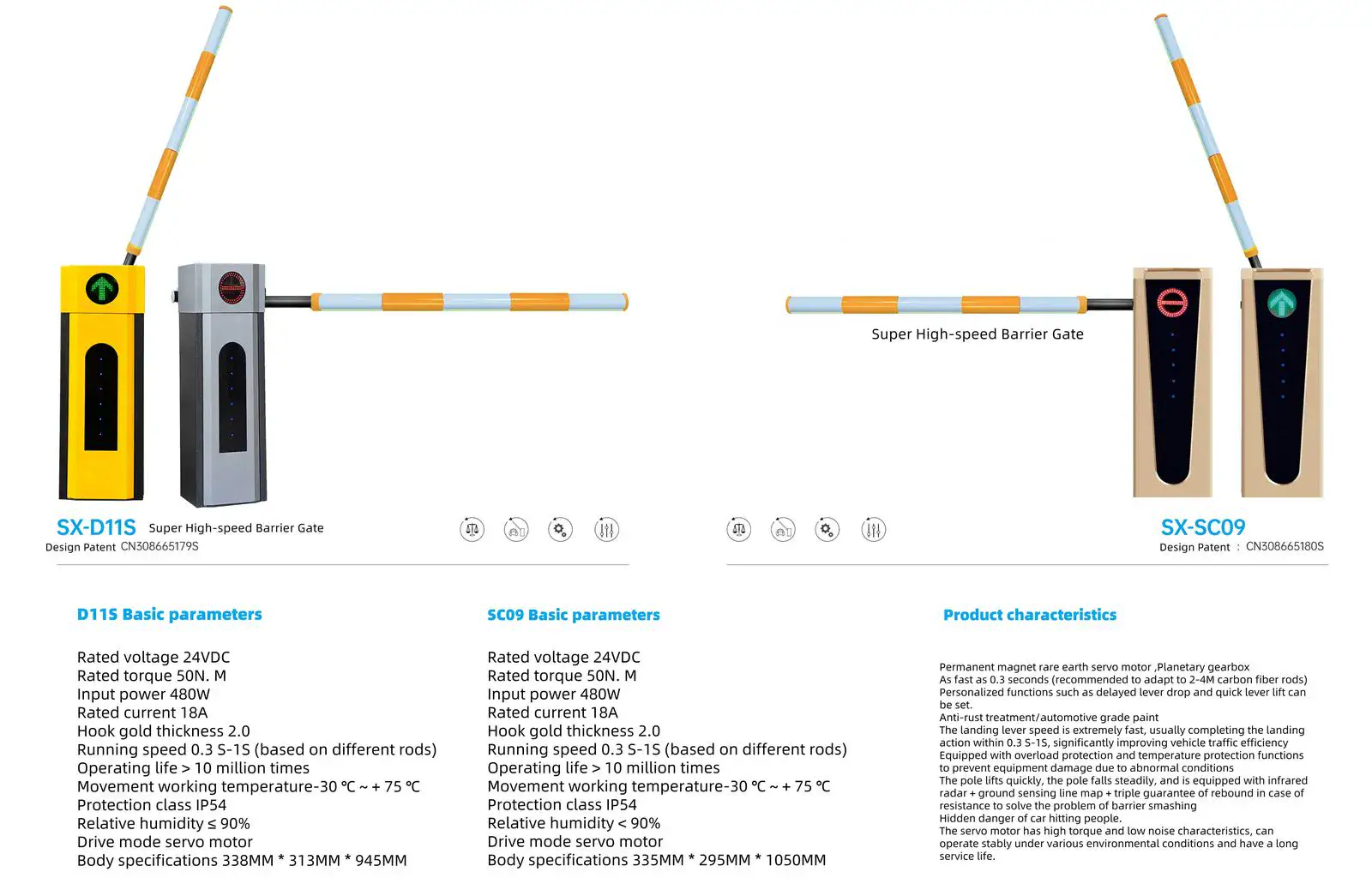
- Speed class. Barrier arms are commonly required to clear the lane in about two seconds, while gates are judged on an opening rate of roughly one foot per second. Our servo-driven high-speed units run 0.3–1 s with a rated life above 10 million cycles and IP54 protection; our brushless DC range runs 3–6 s adjustable, which is the practical choice where the emergency function holds the gate open rather than cycling it at speed.
- Duty and temperature. A fire lane is usually a secondary lane for its own site, so the cycle count is modest — but the gate still has to start after a cold night. Our brushless DC models are rated from −35 °C to +75 °C, and the servo high-speed units from −30 °C to +75 °C.
- Arm design. A breakaway or knock-down arm assembly is strongly recommended on any lane an emergency vehicle may cross; if a vehicle catches the arm, the arm releases instead of tearing the gearbox out of the cabinet. Our components guide shows where that fitting sits in the assembly.

What Has to Happen When the Power Fails, and How Is the Interface Wired?
Power failure is where local requirements diverge most, so read them twice. In residential and multi-family guidelines, gates are commonly required to open freely on loss of power and stay open until power is restored. In commercial and industrial settings, the opposite is often written in: the site stays closed until the emergency switch is used, and the gate then opens on battery backup. Either way, the equipment list is similar:
- A release that works without electricity. A manual release on the operator, a drive that disengages on power loss, or a spring-assisted opening device so one person can open the gate.
- A battery-backed drive. Sized to complete the required number of emergency cycles, with the battery on the site's maintenance schedule. Our backup power guide covers sizing and the difference between UPS and battery options.
- A dedicated emergency input. The controller should have a terminal that forces the gate open and ignores the loop and keypad logic, with a hold-open time and a reset action for staff. Ask for the terminal diagram and keep it with the site drawings.
- US supply voltage. 120 V or 240 V single-phase 60 Hz, with the operator configured for that voltage at the factory rather than adapted on site.
- Status back to the access system. A dry-contact output that reports “gate open” or “emergency active” is worth specifying, so the site knows when the lane is sitting open. Serial or IP signalling (RS-485 or TCP/IP) is available on our controllers where the site network allows it.
- Pedestrian safety. Emergency vehicle lanes and pedestrians should not share a path. Where people walk through the same opening, the site needs a separate pedestrian route with its own release method — see the pedestrian access guide.
What Should You Put in the Factory-Direct Order?
Fire-marshal approval is local; the hardware usually comes from an overseas factory, and the gap between those two facts is where most projects lose weeks. The order below is the shortest version of what to send a supplier so the equipment arrives able to satisfy the approval.
- The approved plan, or the measured clear opening in feet. Not the pier spacing — the clear width the fire marshal signed off, plus the vertical clearance.
- The exact emergency-access device. Model of key switch, preemption receiver or padlock arrangement, the input type it needs (dry contact or a specified voltage), and whether the gate must hold open or reset by timer.
- Voltage and phase. 120 V or 240 V, single phase, 60 Hz, and whether the site needs a control transformer for accessories.
- Speed class and expected cycles per day. This is what separates a happy install from a gate that is blamed for slow response after the first fire drill.
- Detection. Entry loop, safety loop under the arm, photocell or radar — and who supplies each item.
- Backup power and manual release. State the local requirement explicitly, including how long the gate must hold open.
- Documentation and spares. UL 325 compliance statement, ASTM F2200 statement, wiring and terminal diagrams, a commissioning test sheet, and spare arms, springs, loop detectors and batteries so the site is not waiting on an air freight shipment after an impact.
Two commercial factors are worth raising with your customs broker rather than guessing: the correct tariff classification for the operator, and whether any current US measure applies to China-origin access-control equipment in your shipment. Ask for the classification that your broker files, and keep it with the invoice. Our USA buying guide covers the wider purchasing picture, and the manufacturer selection guide sets out the certification and factory checks worth doing before you place the order. Pricing depends on the configuration and is quoted on request — see the price guide for the cost drivers.
How Do You Pass the Fire Marshal's Inspection and Stay Compliant?
Most failures on gated fire lanes are paperwork and maintenance failures rather than hardware failures. The sequence that keeps a project moving looks like this:
- Before ordering: submit the site plan and gate details, obtain the gate permit and the electrical permit, and get the emergency device model approved in writing.
- Before pouring concrete: confirm the clear width, the setback and the device mounting heights against the approved detail sheet, not against the site foreman's recall of the plan.
- At commissioning: demonstrate the emergency device from the vehicle approach side with the fire marshal present, show that the gate holds open and resets, show the signage and strobe, and check whether the site must open on power loss or stay closed until the switch is used.
- During operation: test the operator and the emergency function on the schedule in the operator's instructions, keep a written record for the insurer and the AHJ, and secure a failed gate in the open position until it is repaired.
- After every impact: replace the arm and re-test the emergency function. A gate that was hit and repaired without checking the emergency input is the classic finding at the next inspection.
Our installation and maintenance guide and troubleshooting guide cover the mechanical side of that schedule; the gated community guide deals with the HOA layer of the same problem, and the UL 325 guide explains the standard itself.
FAQ
Does a barrier gate across a fire access road need fire department approval?
Yes. Under the International Fire Code the installation of security gates across a fire apparatus access road must be approved by the fire code official, and the gate must have an approved means of emergency operation that is maintained working at all times. Many jurisdictions also require a permit for each gated entrance and a separate electrical permit for the operator, and approval can be withdrawn if the gate or its emergency device is not maintained.
Is a Knox key switch required on every automatic gate?
Not by national code — the code names categories such as a key box, an approved lock or other approved emergency operation. In practice, though, many fire-prevention offices name a specific device in their gate guidelines, and some go further: a Florida fire prevention notice that follows NFPA 1 requires a Knox key switch on new automatic gated entryways and states that no other system or model will be permitted. Always get your own AHJ's written requirement before the order is placed.
Can we use a siren-operated sensor instead of a key switch?
In many jurisdictions, yes — a sensor that recognises the “Yelp” siren tone is a recognised way to give responding vehicles access. In others it is expressly not allowed and a Knox device is mandatory. Where the fire department uses infrared emitters instead, the site installs a compatible receiver. Because this is decided locally, ask the fire marshal for the accepted method in writing and keep that letter with the gate drawings.
What clear opening width should we plan for?
Plan for the full required width of the fire apparatus access road, which is commonly 20 ft, with roughly 13 ft 6 in of unobstructed height and the open gate or raised arm kept out of that width. Some departments accept a narrower opening at the gate line itself while requiring the full 20 ft beyond it, and some require the gate to be set back a set distance from the intersecting roadway. Every one of those numbers should come off the approved plan for your address.
What should we specify if we buy the gate factory-direct?
Specify the emergency input separately from the normal access control: a dry-contact input that forces the gate open, bypasses the keypad and loop logic, holds the gate open for the period your AHJ requires, and resets only when staff act. Add the supply voltage (120 V or 240 V single-phase 60 Hz), the speed class, the detection devices, backup power, a manual release, and a documentation pack containing a UL 325 compliance statement, an ASTM F2200 statement, wiring diagrams and a commissioning test sheet.
What happens if the power fails or the gate is knocked out of service?
Local rules differ. Residential and multi-family guidelines commonly require the gate to open freely on power loss and stay open until power returns; commercial guidelines often require the site to stay closed until the emergency switch is used, and then to open on battery backup. In both cases, a gate that is out of service for repair is normally secured in the open position, so plan for a manual release, a battery-backed drive and the parts needed to restore the lane quickly.
Conclusion
A barrier gate on a US fire apparatus access road is bought twice: once as access control, and once as a life-safety installation that a fire marshal has to sign off and keep signing off. The hardware that satisfies both is not exotic — a correctly sized arm that clears the measured opening, a speed class that matches the requirement, detection that proves the lane is clear, an emergency input that overrides the whole access-control layer, backup power and a manual release, and documentation that an inspector can read.
What separates a smooth project from a stalled one is usually the order form. Send us the approved clear opening, the emergency device your fire department requires, the supply voltage, the cycle expectation and the documentation list you need, and we will confirm the right barrier-gate model and a factory-direct quotation — contact our engineering team to start. For the wider picture, our USA buying guide and gated community guide cover the rest of the specification.