In this guide
- What a telescopic gate is and how the panels move
- An opening and closing cycle, step by step
- How much space a telescopic gate really saves
- Telescopic vs sliding, cantilever and bi-folding gates
- Panel count, gate height, drive and control options
- Safety, compliance and access-control integration
- Maintenance schedule and the faults that actually happen
- What to put in a factory-direct telescopic gate enquiry
Wide entrances are easy to build and hard to gate. A perimeter opening of 12 m or more is normal at a factory, a distribution centre or a residential compound, and a sliding gate of that length needs a parking bay just as long as the gate itself — space that is often occupied by a wall, a vehicle lane, a fire route or a neighbouring property line.
A telescopic gate solves that geometry problem. Instead of one long leaf travelling the full opening width, the gate is divided into panels that overlap and retract into one another, so the whole gate stacks into a fraction of the space. This guide is written for the people who plan, specify and buy these gates: facility and plant engineers, general contractors, perimeter-security integrators, and importers or distributors who need to match a product line to real site conditions.
It explains how the mechanism works, how to size it, what to specify on the order, and what to check once it is installed. Where a number depends on the manufacturer or the site, we say so instead of quoting a figure that will not survive contact with your opening.
What Is a Telescopic Gate and How Does It Work?
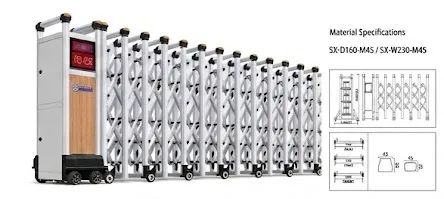
A telescopic gate (also called a telescoping gate, retractable gate or telescopic sliding gate) is a sliding gate whose leaf is split into two, three, four or more panels. When the gate closes, the panels extend end to end across the opening. When it opens, the panels slide into one another and nest inside the smallest panel or behind the leading panel, like the sections of a telescope.
Three elements do the work:
- Panels and running gear. Each panel carries rollers or wheels that run on a floor rail embedded in concrete, or on a bottom track or guide. Some designs are cantilevered and carry the panels on a top beam or a reinforced bottom frame, which removes the ground rail entirely — useful on driveways and yards where a floor rail would collect grit, ice or debris.
- The drive. A single operator drives the leading panel. The remaining panels are not motorised; they are pulled open and pushed closed by a linkage — typically a cable-and-pulley system, a chain, or drive dogs that engage as the leading panel reaches the end of its travel.
- The control. A control panel with limit or encoder feedback starts the cycle, slows the gate at the end of travel, and interfaces with the site's access control: remote, keypad, card reader, loop detector, licence plate recognition or an intercom release.
The important consequence for buyers: a telescopic gate has more moving parts than an equivalent single-leaf sliding gate. More panels mean more running gear, more guide points and one extra linkage to adjust. On the right site that is a good trade — the alternative may be no gate at all — but it does mean the mechanism deserves a proper maintenance routine (see the maintenance section below).

How Does a Telescopic Gate Open and Close, Step by Step?
The sequence below is how a typical multi-panel telescopic gate runs an opening cycle. The exact linkage differs between manufacturers, but the logic is common to tracked and cantilevered designs.
- A command arrives. The controller receives a signal from a remote, a card reader, a loop under the roadway, an LPR camera or a guard using a push button.
- The operator starts the leading panel. The motor accelerates the leading panel. On soft-start operators the first motion is deliberately gentle, which is what protects the linkage and reduces thrust on the piers.
- The trailing panels release. As the leading panel moves, the cable, chain or drive dog engages the next panel, which follows it. On the third and later panels the same happens in sequence, one panel after another.
- The panels nest. Each panel slides past the one in front until the pack is at its minimum length in the parking zone behind the pier or along the fence line.
- The gate stops and holds. Limit switches or an encoder stop the operator. The gate stays open until the closing command arrives — from a timer, a loop, an exit sensor or the access-control system.
- The cycle reverses. The leading panel starts back, pulls the pack out section by section, and the panels extend across the opening until the last panel reaches its end stop. Safety devices such as photocells, radar or a safety edge stay armed throughout the closing travel.
Two practical points follow from this. First, the leading panel always travels further than the others, so on wide openings it is the part that sees the most wear and the part to look at first if the gate starts to lag or bind. Second, because the panels are mechanically linked, a single obstruction under one panel can stall the whole gate — the controller should be set up to detect that overload and reverse or stop rather than keep pushing.
How Much Space Does a Telescopic Gate Actually Save?
The saving comes from simple geometry. If a gate is divided into N panels, the open gate stacks into roughly the width of one panel plus the clearance between panels — so the parking zone shrinks to about 1/N of the opening width.
The table below shows the same 12 m (about 39 ft) opening gated in different ways. Treat the figures as a rule of thumb for planning, then confirm exact stacking length and clearances with the gate supplier for the model you buy.
| Gate type | Space needed along the fence line when open | What that means on a 12 m opening |
| Single-leaf sliding gate | About the full opening width, plus a small overrun | Roughly 12 m (39 ft) of clear run — usually the reason a telescopic gate is considered |
| Two-panel telescopic gate | About half the opening, plus panel clearance | Roughly 6 m (20 ft) of parking zone |
| Three-panel telescopic gate | About one third of the opening, plus clearance | Roughly 4 m (13 ft) of parking zone |
| Four-panel telescopic gate | About one quarter of the opening, plus clearance | Roughly 3 m (10 ft) of parking zone |
Three caveats matter more than the table:
- Panels have a practical length limit. Very long individual panels need heavier frames and more powerful drives. To span a very wide opening, designers add panels rather than making each panel longer — which is exactly what a telescopic gate is for.
- The stacking zone must be genuinely clear. The gate will not nest into a space occupied by a kerb, a sign, a hydrant, a parked vehicle or a slope. Mark the parking zone on the site plan and keep it clear in operation.
- Ground conditions decide the running system. A floor rail needs a level, drained, well-founded track. Where the paving slopes, drains poorly or carries heavy truck traffic, a cantilevered or top-guided design is often the better specification.
If a single-leaf sliding gate does fit, it is usually the simpler and cheaper machine; our telescopic gate vs sliding gate comparison covers that decision directly.
Telescopic vs Sliding, Cantilever and Bi-Folding Gates
All four families do the same job and trade space against complexity. The comparison below is written for procurement and design discussions.
| Design | Space along the fence | Ground track | Best suited to |
| Single-leaf sliding gate | Full opening width | Usually required | Openings up to roughly 8–10 m where the run is unobstructed |
| Cantilever sliding gate | Full opening width, split across the gate and the counterweight side | Not required | Sloping or uneven paving, where a floor rail cannot be maintained |
| Telescopic gate | Roughly one panel width | Rail or track, or cantilevered depending on design | Very wide entrances with little or no side room; industrial and compound gates |
| Bi-folding gate | A little more than half the leaf length, folded | Typically trackless with top or bottom guide | Narrow driveways and entrances with tight piers, where a folded leaf is short |
The pattern is consistent: as you reduce the space the gate needs, you add hinges, linkages, panels and adjustment points. Telescopic gates sit in the middle of that range — less mechanically complex than a multi-leaf folding gate, but far more space-efficient than a sliding gate.
What Types of Telescopic Gates Are Available?
Telescopic gates are usually specified along four axes. Understanding them makes a supplier conversation much shorter:
- Panel count. Two-panel gates are the common residential and light-commercial choice; three- and four-panel gates are used on industrial entrances, compounds and wide service yards. More panels means a shorter stacking zone and a longer open/close cycle.
- Running system. Tracked (floor rail or bottom track with rollers) or cantilevered / top-guided. Tracked systems are simpler and cheaper to build; trackless designs avoid a rail in the roadway, which matters where trucks, snow ploughs or grit pass through.
- Duty class. Residential and community entrances may cycle a few dozen times a day, while a factory gate serving shift traffic, logistics fleets or a logistics yard can cycle hundreds of times a day. The operator, the linkage and the frame must be selected for the real number, not for the average.
- Material and finish. Steel frames and infill with galvanised preparation and a powder-coated finish are standard for perimeter security; aluminium and mixed infill panels are available where weight or appearance drives the decision. Coastal and chemically exposed sites should be specified with a heavier corrosion protection system.
Automation is layered on top of the mechanical choice. Our electric telescopic gate range is built for factory, warehouse and commercial perimeters in custom lengths, and pairs with the same access-control equipment used on barrier gates: remote controls, card readers, face recognition, vehicle detection and intercom release. Where a telescopic gate guards the main entrance and a barrier controls a vehicle lane, the two are usually driven from one access-control platform — see the LPR and barrier integration guide.
How Do You Size a Telescopic Gate for Your Opening?
Sizing a telescopic gate is a drawing exercise, not a catalogue exercise. Six measurements and conditions decide the model:
- Clear opening width. Measure between the inside faces of the piers or posts, not between their centrelines. Add the thickness of any post-mounted equipment the gate must clear.
- Opening height and headroom. Gate height is usually chosen to match the fence line and the required security level, but check for overhead cables, canopies, signage and gatehouse roofs that the panels or top beam must pass under.
- Available stacking zone. Measure the clear run on the stacking side, from the pier backwards, and deduct anything permanent. This is the number that determines the panel count.
- Ground profile. Level and drained paving suits a floor rail; slopes, cambers, soft ground and heavy truck traffic usually push the specification towards a cantilevered or top-guided design.
- Traffic and cycle count. Estimate the busiest hour, not the daily average: shift changes and delivery peaks set the duty class and the required opening speed. High-cycle entrances may be better served by a high-speed barrier gate on the vehicle lane, with the telescopic gate closing the perimeter outside peak hours.
- Wind and exposure. Tall, wide gates with solid infill act as sails. Wind load is a design input for the frame, the running gear and the operator — especially on exposed coastal or elevated sites.
Send these six items to a supplier and you should receive a layout drawing showing panel widths, stack length, foundation or rail details, and the operator position. If the reply is a stock catalogue entry instead of a drawing for your opening, the supplier is not engineering the gate.
What Drive, Control and Safety Equipment Should You Specify?
Specify the automation as a system, because the accessories are what determine whether the finished gate is safe and how much maintenance it demands.
- Operator type and supply. AC operators (commonly single-phase or three-phase, depending on site supply) and DC brushless operators are both used on telescopic gates. State voltage, phase and frequency on the enquiry, and state whether the site has a stable supply or suffers from voltage dips.
- Soft start, soft stop and position feedback. Ramp control reduces shock loading on the linkage and panel guides; encoder or absolute-position feedback makes the cycle repeatable and makes fault diagnosis possible.
- Obstruction detection. Under US practice, automatic vehicular gate operators are expected to be listed to UL 325 with entrapment protection, and automated gate construction to follow ASTM F2200; in the EU and UK, EN 12453 (safety in use) and EN 12604 (mechanical requirements) apply alongside the EN 13241 product standard. Whatever the market, the practical list is the same: a means of detecting an obstruction in the gate's path and a means of reversing or stopping. Typical devices include inductive vehicle loop detectors, photocells, radar, and safety edges on the leading panel. Our safety sensor guide compares them.
- Manual release and standby power. Every powered gate needs a documented manual release for power failure or emergency access, and many sites add a battery backup so the gate finishes its cycle or opens during a power cut — the options are covered in the battery backup guide.
- Access-control interface. Ask for the interface list explicitly: dry-contact open/close, keypad, proximity or RFID reader, face recognition, intercom release, and open protocols such as Wiegand, RS-485 or TCP/IP where the gate must talk to a parking or security platform. Remote and coding options are compared in the remote control guide.
What Maintenance Does a Telescopic Gate Need?
Telescopic gates reward a simple routine, because most failures start as debris, a loose fixing or a dry guide rather than as a dead motor. A schedule that suits most sites:
| Interval | Check |
| Weekly (operator or guard) | Clear the rail, track or bottom guide of grit, gravel, leaves and ice; check that the stacking zone is clear; confirm the gate completes a full cycle from both the remote and the access-control reader. |
| Monthly | Inspect roller and guide wear, tighten visible fixings, check the manual release works, test the obstruction detection devices, and look for fresh rust or damaged powder coating. |
| Quarterly | Inspect the linkage (cables, chain or drive dogs) for stretch and wear, check the operator mounting bolts and the pier or foundation for movement, and review controller diagnostics and any fault log. |
| Annually | Full service: grease or replace running gear as instructed, check the control panel and standby battery, verify limit positions, and re-test every safety device against the operator's instructions. |
Keep a written record. It is the document an insurer, a safety auditor or a warranty claim will ask for, and it is much easier to keep than to reconstruct. Our installation and maintenance guide covers the general schedule for automatic gates, and the troubleshooting guide walks through fault-finding logic that applies to sliding and telescopic drives as well as barrier arms.
What Are the Most Common Telescopic Gate Problems?
Across tracked and cantilevered telescopic gates, the failures that actually show up on site tend to be the same handful:
- Something in the track. Grit, gravel, ice or a settled paving slab under a panel is the single most common cause of a gate that grinds, stalls or stops short. Clear the rail and check the paving first, before touching the controller.
- Panel misalignment or racking. If panels no longer line up, the linkage, a roller or a guide has moved or worn. Forcing the gate to run in this condition damages the panels as well as the drive.
- Linkage stretch or slack. Cables and chains stretch; drive dogs wear. A linkage that has gone slack usually shows up as panels lagging, a jerky cycle or a panel that fails to reach its end stop.
- Operator overload. A gate that binds will push the operator into overload protection and eventually into a trip or a fault code. Repeated overload faults are a mechanical problem, not an electrical one.
- Water and corrosion. Drainage that runs into the rail, or a coastal environment, attacks the running gear and the panel bottoms first. Corrosion protection and drainage details are worth confirming at the specification stage.
- Access-control faults, not gate faults. A gate that ignores a card reader is often a loop, a reader or a network problem — see loop detector faults and the sections on LPR cameras.
One safety rule belongs in this list. A gate that has been hit by a vehicle, has a damaged panel, or is tripping on overload should be taken out of automatic service and left in a safe, preferably open, position until it is repaired — not operated manually with the drive still engaged.

Where Is a Telescopic Gate the Right Choice?
Telescopic gates earn their cost where the entrance is wide and the side space is not. Typical applications:
- Factories and plants. Wide vehicle entrances with a wall or building line close to the pier, where a sliding gate has nowhere to go. The industrial and truck entrance guide covers the traffic requirements at these gates.
- Distribution centres and warehouses. Multiple-lane entrances where the gate closes the whole perimeter outside operating hours and the lanes are controlled by barrier arms or LPR during the day.
- Construction sites, terminals and utilities. Temporary or permanent wide accesses on sites where a long slide track would conflict with drainage, services or vehicle movements.
- Residential communities and compounds. Wide community entrances, often shared with a pedestrian gate and a barrier lane — the access logic is discussed in the gated community guide.
- Sites with a fire-access or emergency route. Where the gate sits on an access route, the emergency opening method has to be designed in from the start, not added later.
What Should Be in Your Factory-Direct Telescopic Gate Enquiry?
Buying direct from the manufacturer works well when the enquiry is complete. Send these items and you avoid most of the back-and-forth that delays a project:
- Opening data. Clear width, required height, stacking-zone length, ground profile and a site photograph or drawing with dimensions.
- Panel and material specification. Panel count or the stacking constraint that determines it, frame material, infill type, colour and finish.
- Operator and supply. Voltage, phase, frequency, duty expectation (cycles per busiest day), required opening time and any preference between AC and DC brushless drives.
- Running system. Tracked or cantilevered, and if tracked, the rail or guide detail and what sits below it in service.
- Safety and access control. The device list (loops, photocells, radar, safety edge, beacon, signage), the readers or platforms the gate must work with, and whether the site needs standby power or a specific manual release.
- Documentation. Wiring and terminal diagrams, control panel manual, a commissioning test sheet, and the compliance statements relevant to your market.
- Spares and wearing parts. Rollers, guides, linkage parts and one spare remote per gate, so a site is not waiting on an air shipment for a consumable.
- Commercial and logistics terms. Packing method, panel lengths as crated, loading plan, Incoterms, and OEM/ODM requirements such as your own branding, panel design or packaging — see the OEM guide. Ask your customs broker for the correct tariff classification and for any measure that applies to your shipment rather than estimating it yourself.
- Supplier verification. Request references for comparable openings and the manufacturing documentation you need; the manufacturer selection guide lists what to ask for.
FAQ
How does a telescopic gate work?
A telescopic gate splits one long gate leaf into overlapping panels. A single operator drives the leading panel, which pulls the remaining panels by cable, chain or drive dog. When the gate opens, the panels nest inside one another and stack in a zone roughly one panel wide; when it closes, each panel extends in turn until the last one reaches its end stop. Most designs run on a floor rail or guide, while cantilevered designs carry the panels on a top beam or reinforced frame so no rail crosses the roadway.
How much space does a telescopic gate save compared with a sliding gate?
A single-leaf sliding gate needs clear space along the fence roughly equal to the full opening width. A two-panel telescopic gate needs about half of that, a three-panel gate about a third, and a four-panel gate about a quarter, plus clearance between the stacked panels. The exact stack length depends on panel construction and the operator, so treat these proportions as planning rules of thumb and confirm the figure on the supplier's layout drawing for your opening.
Does a telescopic gate need a concrete track or floor rail?
Not always. Tracked telescopic gates run on a floor rail or bottom track that is embedded or fixed in a level, drained foundation. Cantilevered or top-guided telescopic gates carry the panels on a beam or frame instead, which suits driveways, sloping paving or roadways where a rail would be damaged or would collect debris. The choice is a site decision: tell the supplier what crosses the opening and what the paving is like.
Can a telescopic gate be automated and integrated with access control?
Yes — that is the standard configuration. The operator is triggered by remote control, keypad, card or proximity reader, face recognition, intercom release, vehicle loop detector or licence plate recognition, and the control panel is normally expected to provide a dry-contact open input plus whatever protocol the site's parking or security platform requires, such as Wiegand, RS-485 or TCP/IP.
How wide an opening can a telescopic gate cover?
Manufacturers build telescopic gates for openings from a few metres up to very wide industrial entrances, with the panel count increased as the opening grows. What limits the design is not the total width but the available stacking zone, the ground profile, the wind exposure and the number of cycles the gate must perform each day. Give the supplier the clear opening, the usable stacking length and the traffic pattern, and they should recommend the panel count rather than quote the largest stock model.
What safety devices are required on an automatic telescopic gate?
The requirement depends on the market. In the United States, automatic vehicular gate operators are expected to be listed to UL 325 with entrapment protection and automated gate construction is addressed by ASTM F2200; in the EU and UK, EN 12453 and EN 12604 apply together with the EN 13241 product standard. In practice the gate needs a means of detecting an obstruction — loops, photocells, radar or safety edges — together with a reversing or stopping function, warning signage, a manual release, and a periodic test routine recorded by the site.
Conclusion
A telescopic gate is the engineering answer to a simple problem: a wide entrance with nowhere for a gate to slide. Split the leaf into overlapping panels and the gate folds back into about one panel of space, which is why these gates are standard at factory compounds, warehouses, logistics yards and community entrances.
The specification work is what separates a gate that runs for years from one that is adjusted every month. Fix the clear opening, the stacking zone, the ground profile, the cycle count and the safety and access-control list before the enquiry goes out; ask for a layout drawing, a commissioning sheet and the compliance statements relevant to your market; and keep the running gear clear and adjusted to a written schedule.
If you are planning a wide entrance, send us the opening dimensions, a site photo and your traffic pattern. We will come back with a panel layout, the recommended operator and the accessory list for your site — contact our engineering team or review the electric telescopic gate range first.